Lucky Hills operator and Curaçao licence explained
 Available in AU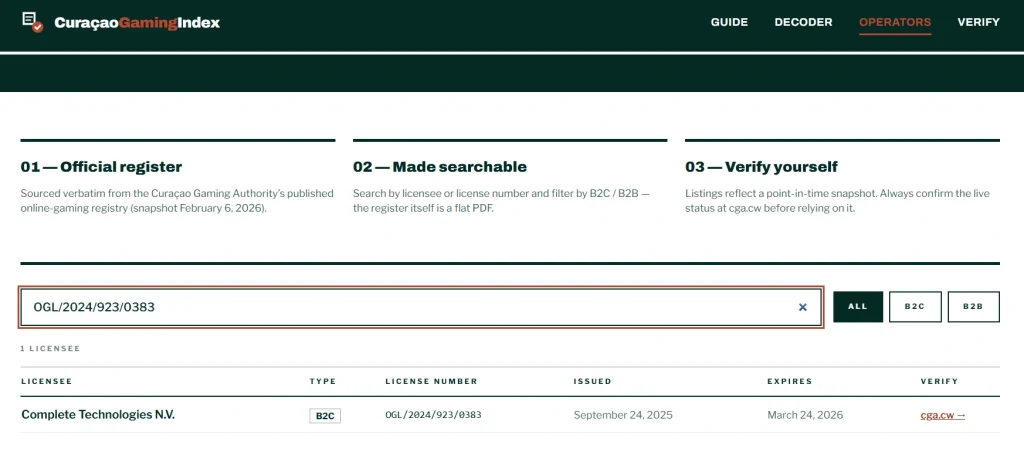
The Lucky Hills licence evidence used for this review associates the brand with Complete Technologies N.V. and records Curaçao licence OGL/2024/923/0383, with licensing evidence linked to luckyhills.com. That is useful operator-level information, but it has a defined scope. It supports the statement that an offshore licensing relationship is recorded; it does not establish that Lucky Hills holds an Australian gambling licence, is authorised as an online casino in Australia, or receives Australian regulatory protection.
Complete Technologies N.V. and the Lucky Hills brand
Available evidence associates Complete Technologies N.V. with the operation of Lucky Hills. This distinction between operator and brand is worth preserving. Casino websites are commonly known by a trading or brand name, while regulatory records are organised around legal entities. Searching only for “Lucky Hills” can therefore miss the entity that appears in licensing documentation.
When comparing evidence, use three identifiers together: brand, operator and domain. If all three point to the same service, the licensing claim is much easier to interpret. If they do not align, the discrepancy needs resolving before a licence number is repeated as fact.
The Curaçao licence recorded for the operator
The available evidence records Complete Technologies N.V. as holding Curaçao licence OGL/2024/923/0383 and records licensing evidence that identifies luckyhills.com. Licence numbers and statuses are details that deserve a current check because regulatory records can be updated. A copied badge or an old review is weaker evidence than the current licensing source.
The number is useful because it makes the claim specific and testable. It allows a reader to compare the entity and domain against the licensing record rather than relying on a generic statement that the casino is “licensed”. Specificity also makes mismatches easier to spot.
| Licence element | Recorded for Lucky Hills | Why it matters |
|---|---|---|
| Operator | Complete Technologies N.V. | Identifies the legal entity rather than only the casino brand. |
| Jurisdiction | Curaçao | Shows which licensing system the claim belongs to. |
| Licence reference | OGL/2024/923/0383 | Provides a specific record to verify. |
| Domain evidence | luckyhills.com is identified in the recorded licensing evidence. | Connects the licence evidence to the service being reviewed. |
Why the jurisdiction label matters
A licence is not a borderless permission. It belongs to a particular regulatory system and should be described that way. Saying that Lucky Hills has a Curaçao licence is materially different from saying that it is licensed in Australia. The first statement describes the offshore licensing evidence. The second would require separate Australian authority and is not supported by the available evidence.
This is why the broader Lucky Hills Australian legal context page treats offshore licensing and Australian rules separately. A reader can acknowledge the Curaçao record without turning it into a claim about Australian authorisation.
What a licence record can establish
At its most useful, a licensing record helps answer who stands behind the service, which jurisdiction issued the licence, what reference number applies and whether the relevant domain is connected to the licence evidence. These are concrete verification points. They are more informative than a licence logo presented without an entity name or reference.
A licence can also give readers a place to start when checking regulatory information. That does not mean every complaint or transaction dispute will be handled in the way an Australian consumer expects. The applicable process depends on the licensing jurisdiction, the operator’s terms and the nature of the issue.
What the Curaçao licence does not prove
The offshore licence does not prove that Lucky Hills is an Australian licensee. It does not place the casino on an Australian register merely because Australian readers can encounter the site, see AUD-oriented content or find familiar payment methods. It also does not mean Australian law treats online casino services in the same way as licensed wagering services.
Those limits are not technicalities. They prevent a common reasoning error in casino reviews: taking a genuine licence from one jurisdiction and presenting it as universal regulatory approval. The accurate wording keeps the jurisdiction attached to the licence claim.
How to check a licence claim rather than a licence badge
Begin with the legal entity. Compare the operator name shown in current terms or licensing material with the name in the regulator’s record. Then check the domain. A valid record for an unrelated site or another company does not verify the service you are reviewing. Finally, compare the licence number and status with the current source.
Do not rely on visual similarity. A licence badge can be copied, redesigned or shown without enough context to identify the underlying record. The verification value comes from the record behind the badge. Save the current source or note the date of the check if the licence status is important to a decision.
Why licence details can need rechecking
Operators can change corporate structures, domains can be added or removed, and licensing systems can update their records. That is why exact licence numbers and status statements should not be treated as timeless copy. The available evidence supports the current claim, but a later reader should still confirm the live record before relying on it for a current regulatory decision.
The same principle applies to casino terms more broadly. Current bonuses should be checked on the casino’s own page because they can change. Licensing information changes less frequently than promotions, but its consequences are more significant, so a fresh check is still worthwhile.
Offshore licensing versus Australian protection
For Australian readers, the practical distinction is between identifying an offshore regulator and establishing local authorisation. The Lucky Hills evidence supports the former. Australian online gambling rules are a separate layer, and ACMA material should be used for that layer rather than inferring Australian status from the Curaçao record.
The site’s ACMA rules guide covers that Australian framework in more detail. Keeping the two sources separate makes the analysis cleaner: Curaçao evidence for the offshore licence, Australian regulator evidence for Australian law.
A practical licence-checking sequence
First, identify the brand’s current domain. Second, identify the operator name attached to the service. Third, find the licensing record and compare the entity, domain, licence reference and status. Fourth, identify the jurisdiction that issued the licence. Fifth, if your question is about legality or consumer protection in another country, check that country’s regulator separately rather than assuming the offshore licence answers it.
This sequence is deliberately simple. It reduces the chance of mixing a product feature with a legal credential or mixing one jurisdiction’s licence with another jurisdiction’s rules. It also gives you a repeatable method that can be used if the brand changes operator or domain later.
Licence evidence should be separated from marketing language
A casino can describe itself with terms such as licensed, regulated or secure, but those words are not substitutes for the underlying record. The useful evidence is the legal entity, jurisdiction, licence reference, status and domain connection. Marketing language may summarise those facts, yet the verification should still return to the regulatory source rather than treating the casino’s own wording as the final proof.
This also helps when two pages use slightly different brand or company names. Corporate suffixes, trading names and domain labels can look inconsistent while still referring to a connected operation, or they can reveal a genuine mismatch. Comparing the exact entity and licence reference is more reliable than deciding from visual branding alone.
What to record when you perform your own check
If you verify the licence yourself, note the date, operator name, licence number, status and domain shown by the source. A short record makes later comparisons easier if the casino changes its terms or if the regulator updates the entry. It also prevents a current check from being confused with an older saved image circulating on a review site.
Keep the scope of the note precise. Recording that a Curaçao licence is active is not the same as recording that the service is authorised in Australia. The first statement belongs to the offshore record. The second requires Australian regulatory evidence and should never be inferred from the first.
What the Lucky Hills offshore licence does and does not establish
The recorded evidence connects Lucky Hills with Complete Technologies N.V. and a Curaçao licence, including a specific licence reference and domain evidence. That supports a precise offshore licensing statement. It does not support describing Lucky Hills as Australian-licensed or treating the Curaçao record as Australian authorisation. For an Australian reader, the sound approach is to verify the offshore record on its own terms and then assess Australian legal context from Australian regulatory sources.