Lucky Hills licence, operator and Australian legal context
 Available in AU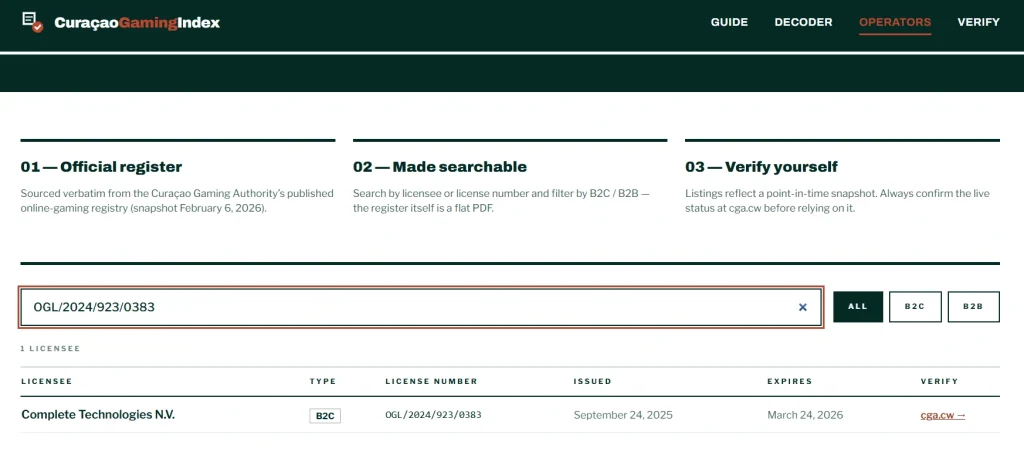
Lucky Hills is associated with Complete Technologies N.V. and the source material records a Curaçao licence for that operator. For an Australian reader, that offshore licence must be kept separate from Australian authorisation. Australian rules under the Interactive Gambling Act prohibit online casino services from being offered to people in Australia, and ACMA enforces those rules. A Curaçao licence can establish an offshore regulatory relationship; it does not turn Lucky Hills into an Australian-licensed online casino or provide the same Australian regulatory protections.
Who is associated with Lucky Hills
The operator evidence in the available evidence associates Lucky Hills with Complete Technologies N.V. That name matters because a casino brand, website and legal operator are not always identical. When checking licensing information, the useful comparison is between the operator named in the casino material and the entity named by the licensing source. A brand name on its own is not enough to establish who holds a licence.
This is also why readers should avoid treating a logo, an AUD balance or Australian-facing wording as evidence of corporate status. Those features describe presentation or product access. Operator identity comes from legal and licensing material. The dedicated Lucky Hills licence page focuses on that evidence and the limits of what it establishes.
The Curaçao licence recorded for the operator
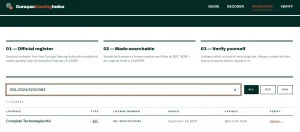
The current information records Complete Technologies N.V. with Curaçao licence OGL/2024/923/0383 and links the licence evidence to luckyhills.com. Because a licence number is a high-risk detail that can change or be affected by regulatory updates, it should be checked against the current licensing record when making a time-sensitive decision. The important structural point is that the licence is Curaçao-based, not an Australian state or territory gambling licence.
An offshore licence can provide information about the operator and the jurisdiction under which it is licensed. It should not be expanded into claims that the operator is approved by Australian authorities. Different regulators apply different statutes, licence conditions, complaint processes and enforcement powers. A licence in one jurisdiction does not automatically transfer those protections into another jurisdiction.
What Australian law says about online casino services
ACMA states that the Interactive Gambling Act 2001 makes it illegal for gambling providers to offer certain online services to people in Australia, including online casinos. The rule is directed at the provision of the service. That is an important distinction when reading a casino review: technical accessibility, a familiar payment method or a site displaying Australian dollars does not by itself answer whether the service may lawfully be offered to people in Australia.
The Australian framework also distinguishes online casino services from regulated interactive wagering services. The categories are not interchangeable. A register of licensed interactive wagering providers should not be read as a general licence list for online casinos. For Lucky Hills, the relevant question is not whether its offshore licence exists, but what that licence means alongside Australia’s separate prohibition on online casino services.
| Question | What the evidence supports | What it does not establish |
|---|---|---|
| Who is associated with Lucky Hills? | Complete Technologies N.V. | That the operator is an Australian licensee. |
| Is an offshore licence recorded? | Yes, the available evidence records a Curaçao licence. | Australian authorisation or Australian regulatory protection. |
| What is Australia’s position on online casinos? | ACMA identifies online casinos as prohibited interactive gambling services. | That access to a website makes its offer lawful in Australia. |
| Who enforces the federal interactive gambling rules? | ACMA enforces the Interactive Gambling Act. | That every offshore dispute can be resolved through Australian casino regulation. |
ACMA’s role is more than maintaining information pages
ACMA is the federal communications and media regulator responsible for enforcing the Interactive Gambling Act. Its enforcement material describes investigations and action where operators provide or advertise prohibited online gambling services. Website blocking is one of the disruption tools used against illegal gambling websites. This makes ACMA material the appropriate starting point for the Australian legal layer of the analysis rather than affiliate descriptions of what is or is not “allowed”.
The regulator can ask Australian internet service providers to block access to websites in circumstances involving breaches of the Interactive Gambling Act. A block is an enforcement measure, but the legal framework does not depend on a particular brand already appearing on a public block list. The broader statutory category matters. Readers can use the separate ACMA and offshore casino guide for a focused explanation of those rules.
Advertising is a separate compliance issue
Australian rules also prohibit advertising prohibited interactive gambling services. This matters for how information about offshore casinos is presented. Describing a brand’s features is not the same analytical question as establishing that it may be promoted to Australian consumers. ACMA’s enforcement record includes action concerning advertising and services that direct Australian users toward prohibited online casino products.
For a reader, the practical takeaway is to separate product information from regulatory status. A bonus description, game list or payment explanation should never be used as a shortcut to infer that the underlying casino service has Australian approval. Current bonuses should be checked on the casino’s own page because they can change, but even a current offer says nothing by itself about Australian authorisation.
The 2026 reforms do not erase the basic distinction
ACMA’s current material notes 2026 reforms that strengthen gambling advertising, direct-marketing and enforcement settings, with many measures commencing in 2027. Those reforms sit alongside the existing Interactive Gambling Act framework. For this review, the useful point is not to turn every legislative change into a claim about Lucky Hills. It is to recognise that Australian gambling regulation continues to evolve and that current regulator guidance should be checked for time-sensitive legal questions.
The core distinction remains clear: an offshore operator can have a licence from an overseas jurisdiction while Australian law separately governs what services may be offered to people in Australia. Those two facts can exist at the same time without contradiction.
Why AUD support does not settle the legal question
Lucky Hills is presented with Australian-facing features and payment information, but localisation is not a licence. Australian dollars can be a convenient account or display currency; they do not indicate that ACMA or an Australian state or territory authority has authorised an online casino. The same applies to Australian terminology, local-looking promotions or payment methods familiar to Australian users.
This separation is useful beyond legal analysis. On the Lucky Hills payments page, the question is which payment categories and currencies are presented and what a user should verify in the cashier. On this page, the question is regulatory status. Keeping those intents separate prevents a technical feature from being misread as a legal credential.
What an offshore licence can tell you
A verified offshore licence can help identify the legal entity connected with a service and the regulator or licensing jurisdiction that issued the permission. It can also provide a reference point for checking whether the licence record remains active and whether the domain is connected to that record. Those are meaningful facts, especially when the operator name is less visible than the casino brand.
But the licence should be read within its jurisdiction. It does not automatically create rights under Australian gambling law, place the operator on an Australian wagering register or make Australian consumer-protection mechanisms applicable to an offshore online casino dispute. When a review collapses all of those ideas into the single word “licensed”, it hides the most important distinction for an Australian reader.
What to verify yourself before relying on a licence claim
Start with the operator name and current domain. Then compare those details with the current licensing record rather than relying on a copied licence badge or a review written months earlier. Check whether the record identifies the same entity, whether the domain is covered and whether the status is current. If a licence number is displayed, compare it character by character rather than assuming similar numbers refer to the same licence.
Next, check the Australian side independently. Use ACMA material for the Interactive Gambling Act and current enforcement guidance. Do not treat an overseas regulator’s record as a substitute for Australian rules. Conversely, do not use the absence of an Australian online-casino licence as proof that the offshore licence itself is fictitious. These are different factual questions.
Accessibility and authorisation are not synonyms
An offshore website may be technically reachable at a particular moment, and an account interface may show Australian dollars or payment options. None of those observations should be translated into the statement that the service is authorised in Australia. Technical access can change because of operator decisions, ISP blocking, geolocation, account settings or other factors. Regulatory status has to be established from the applicable rules and regulator evidence.
This distinction also prevents the opposite mistake: assuming that a temporary technical block proves a specific legal finding about the brand. A blocked page can have several causes. For Australian legal context, the stronger evidence is ACMA’s published framework and any brand-specific enforcement material where it exists.
Consumer protection is part of the practical difference
ACMA warns Australians about illegal offshore gambling services and notes that they may lack important customer protections. That warning is relevant when comparing an offshore licence with Australian authorisation. The issue is not simply where a company is registered. It is which regulator and legal system govern the service, what enforcement tools apply and what avenues exist if something goes wrong.
A reader should therefore avoid treating “licensed” as a universal quality label. The more useful questions are: licensed by whom, for which entity and domain, under which jurisdiction, and does that licence establish permission to offer this service in Australia? For Lucky Hills, the verified offshore licence evidence answers the first set of questions but does not convert the service into an Australian-authorised online casino.
How to read other Lucky Hills pages with this context
The rest of this site separates product information from regulatory interpretation. Game availability, payment categories, account processes and bonus information can be described from their own evidence without pretending those features prove local licensing. Likewise, the legal page does not need to deny the existence of product features simply because the Australian regulatory position is different.
That separation is especially important for bonuses. Current bonuses should be checked on the casino page because they can change. A promotion can be current as a product fact while still having no bearing on whether the underlying online casino service is authorised to be offered to Australians. The same logic applies to games and payment methods.
Why brand-specific enforcement evidence should be read carefully
Australian regulator material can describe the general legal category and can also publish actions involving named services. Those are different kinds of evidence. A general statement that online casino services are prohibited explains the framework; a named enforcement notice establishes something more specific about the service identified in that notice. Do not manufacture a brand-specific ACMA finding merely because the general rule applies to the service category. If a current named action is relevant, it should be supported by the regulator’s own publication.
This evidence discipline matters because block lists and enforcement pages change over time. A site not appearing in a particular list is not automatically authorised, just as a technical access problem is not automatically proof of a named enforcement decision. The strongest legal explanation combines the general statutory category with current brand-specific regulator evidence only when that evidence actually exists.
The distinction Australian readers need to make about Lucky Hills
Lucky Hills has operator and offshore licensing evidence in the available evidence: Complete Technologies N.V. is associated with the brand and a Curaçao licence is recorded. Australia, however, has its own legal framework. ACMA states that online casinos are prohibited interactive gambling services that must not be offered to people in Australia and enforces that framework through investigations and disruption measures. The accurate reading is therefore two-part: recognise what the Curaçao licence establishes about the offshore operator, and separately recognise that it is not Australian authorisation.